
More Yield. Less Land.
No Soil Required.
Hydroponic farming systems that produce lettuce, tomatoes, cucumbers and peppers every month, all year round.
Designed and installed by Nigeria’s most experienced agricultural technology company.
Months of continuous production
Land Is Expensive. Soil Is Unpredictable.
There Is a Better Way.
Acquiring and preparing arable land in Nigeria is expensive, slow and increasingly competitive. And even when you have the land, soil quality, pest pressure and seasonal dependency still determine whether your farm is profitable.
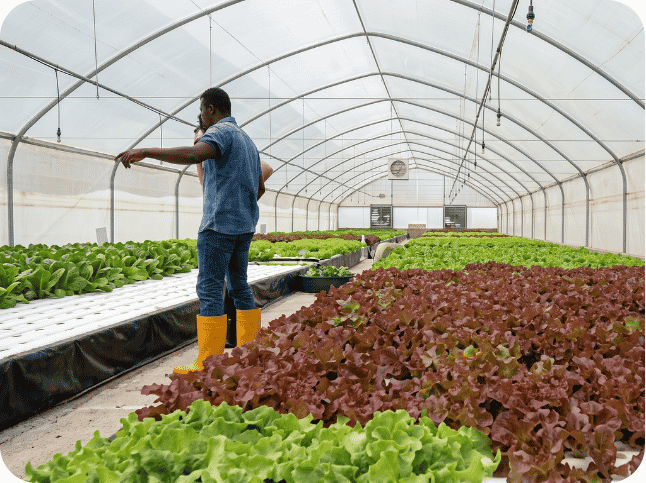
Hydroponic farming removes all three variables from the equation. The crop grows in a precision nutrient solution not soil. The facility is enclosed, pest pressure drops significantly. And because the system controls the growing environment, the calendar becomes irrelevant. Lettuce in January. Tomatoes in August. Cucumbers through harmattan. The same system, producing on a schedule you set.
What this means commercially is straightforward. A hydroponic facility produces four to six times more crop cycles per year than equivalent open-field farming on the same footprint. The produce is consistent in size, quality and timing, which is exactly what supermarkets, hotels, food processors and institutional buyers require before they will commit to a supply contract. Hydroponics does not just improve your yield. It changes the category of buyer you can serve.
No soil. No seasons. No land clearing. Just crops growing in precisely controlled conditions
Soil Is Optional. Nutrients Are Not.
Hydroponic systems deliver water, oxygen and nutrients directly to the plant root, suspended in a controlled growing medium or nutrient solution. The plant gets exactly what it needs, exactly when it needs it. The result: faster growth cycles, higher yield per square metre, and consistent produce quality.
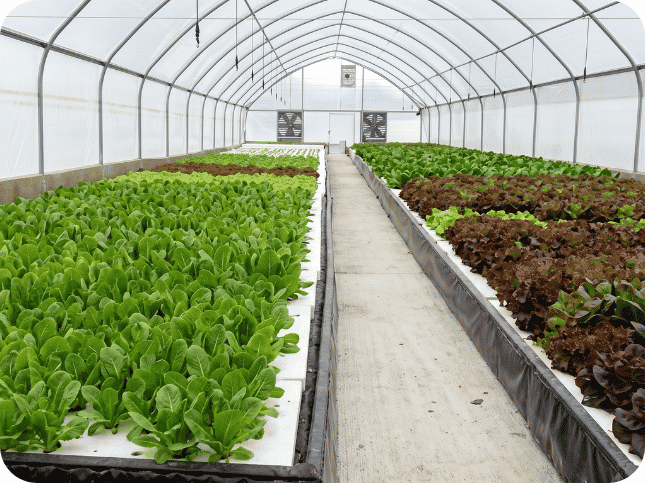
Nutrient Film Technique (NFT)
A thin film of nutrient solution flows continuously over plant roots in angled channels. Ideal for leafy greens, lettuce, spinach, herbs. Features a rapid 28-day cycle, extremely high volume, and a low spatial footprint.
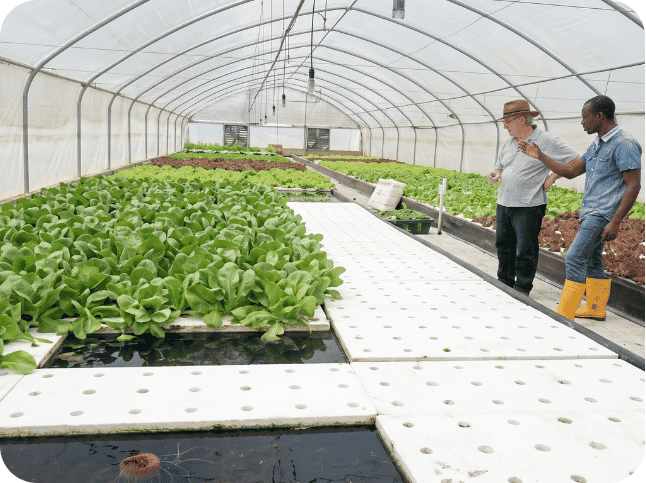
Floating Raft (DWC)
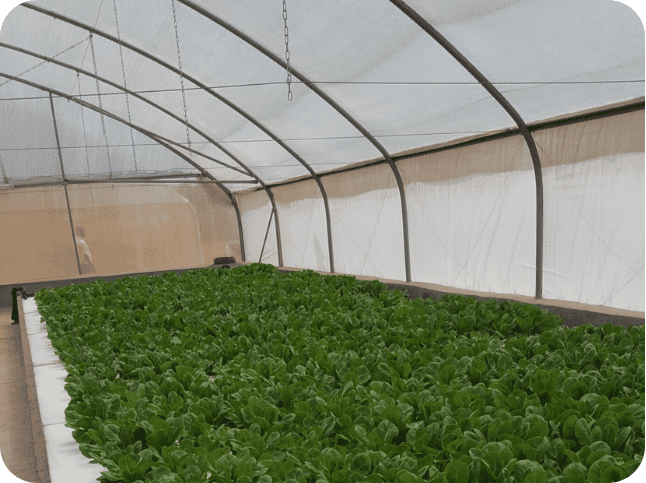
Plants sit in specialized foam boards floating directly on a deep nutrient solution reservoir. Highly stable, low-maintenance, and incredibly productive for lettuce and leafy crops at a large institutional scale.
Crops That Produce Every Month
| Crop | Cycle Time | Production Notes |
|---|---|---|
| Lettuce | 28 days | Highest volume, fastest turnover |
| Tomatoes | 60–90 days | Premium market value |
| Cucumbers | 45–60 days | Consistent supermarket demand |
| Peppers | 60–90 days | High-value, year-round supply |
| Spinach / Herbs | 21–30 days | Institutional catering demand |
Frequently Asked Questions
No. Hydroponics can run in a net house, adapted building, or shade structure. However, in Nigeria’s climate, some form of protection is strongly recommended to shield the system from rain, heat, and pests. We assess your space and recommend the right setup for your goals and budget.
You can start with as little as 50–100 square metres; enough for a productive, income-generating setup. For commercial scale, most clients begin with 500–1,000 square metres. The right size depends on your crop, target market, and budget. We help you figure that out before anything is built.
Main running costs include nutrients, water, energy, growing media, and labour. Hydroponics uses up to 90% less water than soil farming and delivers faster crop cycles and higher yields, making operating costs more efficient over time. We provide a full cost-benefit breakdown before you commit.
Yes. Hydroponics is highly scalable. We design every installation with expansion in mind so your water supply, nutrient lines, and framework can accommodate growth without rebuilding. Many clients start with a pilot unit, generate early returns, and scale up in phases with confidence.
We provide pre-handover operator training, tailored operational manuals, ongoing agronomic advisory, remote troubleshooting support, and scheduled on-site visits. With 35 years of in-country experience, our team stays involved throughout the life of your system not just at installation.